 BUY ART


Elyse Pignolet: The Revolution Will Not Be Televised
We’re pleased to present Los Angeles-based artist Elyse Pignolet’s third solo exhibition at Track 16 titled The Revolution Will Not Be Televised, which runs through October 25 and kicks off with a reception on Saturday, September 13 from 6-9 p.m.
It is injustice on a global scale that serves as the overarching theme within Pignolet's new body of work. It’s a response to Trump's second term, the chaos of unrest and protests, government takeovers of U.S. cities, mass deportations, rollbacks on human rights and voting rights, the weakening of DEI initiatives, the fragility of democracy, and multiple wars. The ceramics and paintings in the show are the result of processing this ever-changing environment, while pondering what it means to be an artist in the face of this destruction.
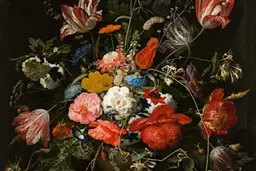
This new series of artworks developed in response to women’s rights and ideas about consent; in particular, the French court case of rape victim Gisele Pelican, the overturning of Roe v. Wade, and the different US States banning and/or creating strict laws about abortion. Also, witnessing the aftermath and loss of women’s lives caused by these restrictions and wanting to memorialize their names and highlight the importance of resistance. The intensely publicized case of Gisele Pelicot, whose husband had secretly drugged and allowed men to rape her over many years, particularly spurred Pignolet’s work. In France – and most European countries – current law defines rape as coming from acts of violence or surprise–not by an absence of consent. In response, Pignolet created a large-scale collaged work on paper that acts as a monument to consent, quoting Pelicot’s statements around a vase of flowers.
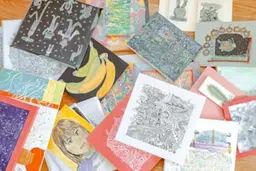
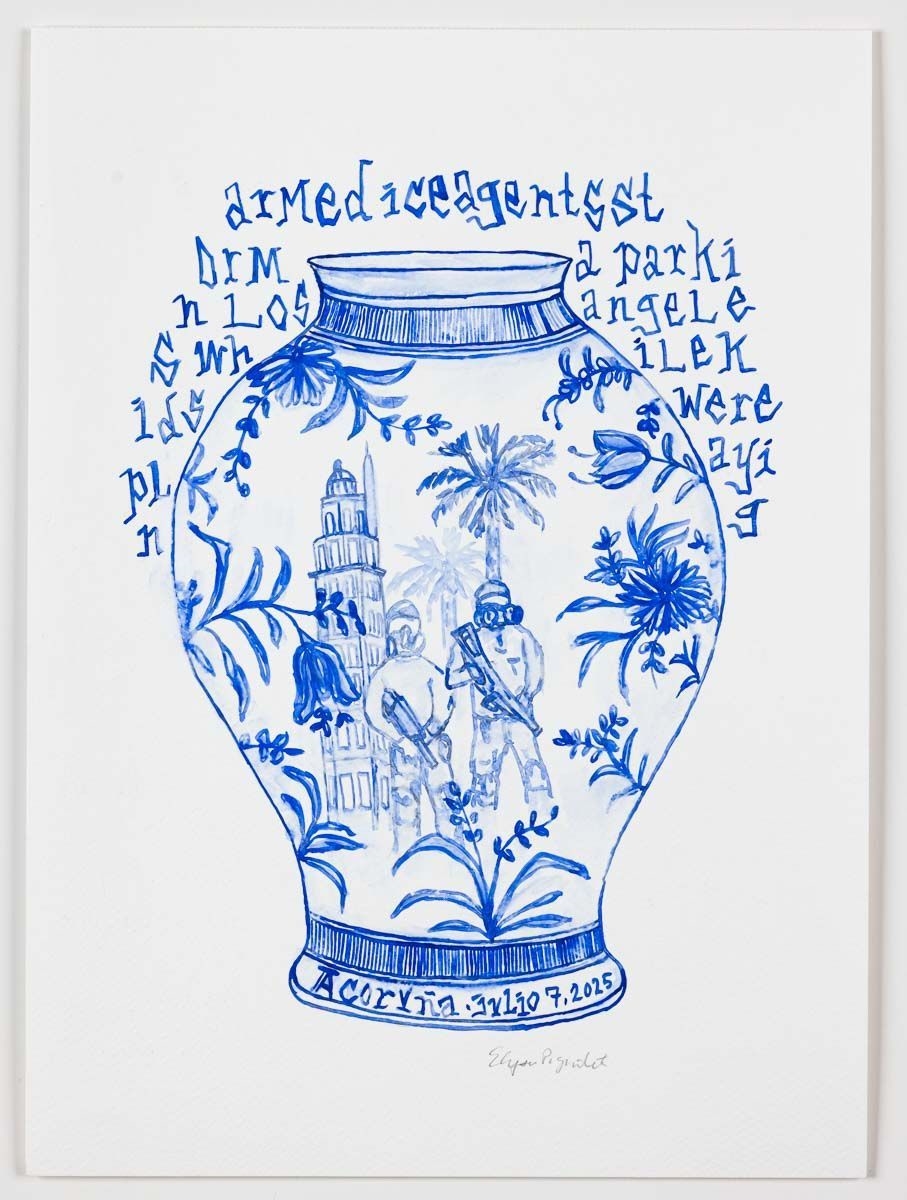
In this new body of work, the artist builds upon her characteristic blue and white tradition. Sumi inked works on paper depict delicate floral patterns, figures, and ceramics vessels along with text. The letterings are arranged in such a way that the viewer must slow down to decipher, not only the literal message, but also the actual event being described. While the public is inundated with the news cycle, Pignolet slows down each horror as it comes – from Texas floods, to deportations, the depravities of the war in Gaza, or the death of a woman forced to give birth.
In the center of the gallery, the artist has created a presentation of “High-Fire Ware”, something like what you would see at an exposition for commercial production. Anchoring these ceramic works , hers with are four sugar bowls at each corner. Since the late 18th century, ceramic sugar bowls have been used to protest the legacies of colonialism, slavery, racial stereotypes, and for political messages during the American Revolutionary era. In the early 20th century, they were used by the Women’s Social and Political Union to raise funds for supporters and for women to display their activism in their own homes. Pignolet uses her sugar bowls as a blunt symbol for our current violent and exploitative government of today and to suggest a reflection on our own transactional approach to US domestic and foreign policy.
Yet, the title of the show, named after the song “The Revolution Will Not Be Televised” by Gil Scott-Heron (1971), offers some hope. The lyrics of the song depict an antidote to political burnout and apathy, describing—for the time—the disconnect between the consumerism celebrated on TV and the protests happening in the streets. These lyrics prove to mirror our own political environment today. This seed of revolutionary hope is embodied in the symbol of the butterfly, which Pignolet uses as a theme within the show. For Pignolet, butterflies are known to be a symbol of fragility and the fragility of life but also a symbol of change. The butterfly effect is a property of chaotic systems by which small changes in initial conditions can lead to large-scale and unpredictable variation in the future state of the system. As the artist ponders, "I wonder what small changes I can make to effect a more positive future?"
Artist on show: